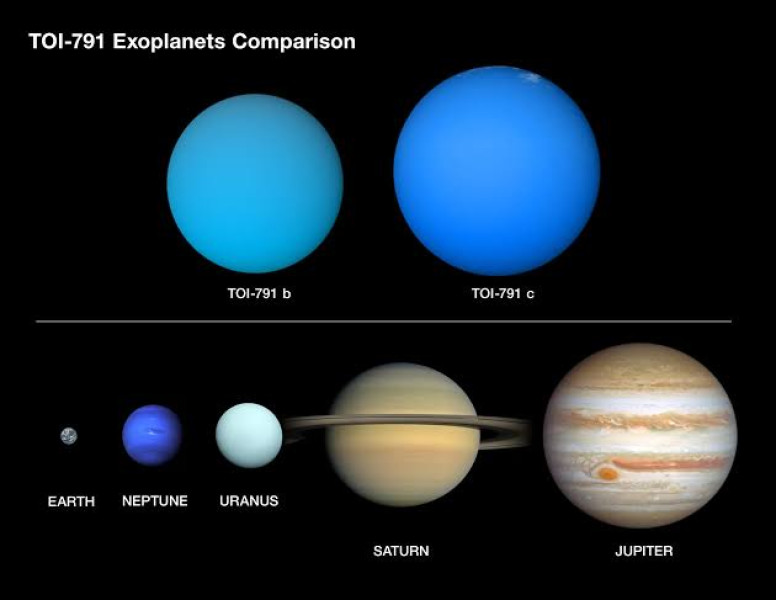
NASA has discovered two unusual planets that are puzzling scientists because of their extremely low density despite their massive size. The planets, named TOI-791 b and TOI-791 c, are located about 1,110 light-years away from Earth and have been described as some of the strangest worlds identified in recent years.
According to researchers, both planets are comparable in size to Jupiter, the largest planet in our solar system. However, unlike Jupiter, they are surprisingly lightweight. Scientists estimate that these planets are about 35 times lighter than Jupiter, making them exceptionally low-density objects in space. Their structure is so light that researchers have compared them to “cotton candy” planets.
Studies indicate that TOI-791 b and TOI-791 c are composed mainly of hydrogen and helium, the same gases that dominate many giant planets. Their unusually low mass and large size have attracted significant scientific interest because they challenge current understanding of planetary formation and evolution.
Astronomers believe that further observations could provide valuable insights into how such planets develop and survive in their star systems. The discovery may also help scientists better understand the diversity of planets that exist beyond our solar system.
NASA continues to explore distant worlds using advanced observation technologies, revealing new details about the universe and expanding knowledge of planetary systems far beyond Earth.
The discovery of TOI-791 b and TOI-791 c highlights how much remains to be learned about the cosmos and the extraordinary variety of planets that exist across the galaxy.


















0 Comments